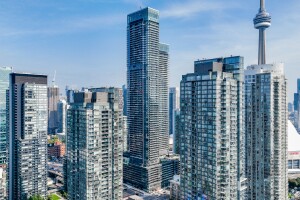
Canada’s housing market is entering a structural transition in which near‑term conditions in major urban centers increasingly favour renting over buying. One consequence of these dynamics may be that more first-time buyers consider homeownership options outside urban centres.
The federal budget has earmarked $110 billion for productivity and competitiveness programs over the next five years. Developing homegrown AI solutions and encouraging companies to invest in improving productivity are key priorities for the government, which also aims to enhance the efficiency of its own operations.
Canada’s housing crisis is multifaceted: Picture a Venn diagram of overlapping issues involving affordability, availability and price stability. In an ideal world, home prices would remain relatively flat on a nominal basis while the country increased productivity and wage growth, helping to address housing affordability issues.
The industrial property investment market in Toronto has fluctuated significantly, a phenomenon that shows up when comparing completed sales from the first 11 months of each year.
Toronto’s office investment market still faces significant headwinds, with sales volumes plummeting to $1.05 billion in the first 11 months of 2025 from $4.28 billion in 2022, the lowest since the pandemic's onset. But investor sentiment toward office space is gradually improving.
Investment in Toronto retail properties has had a strong run, but signs of cooling are beginning to emerge in a reflection of both market dynamics and shifting investor priorities.
Investor sentiment toward the office market has become more positive, spurred by the Ontario provincial government’s worker mandate of five days of in-office attendance starting in January and major banks signaling a full return of staff to the workplace. But the office performance narrative is far more complex.
The housing boom that took place in Canada during 2020–2021 was driven by historically low interest rates and pandemic-induced demand. In Toronto, home sales peaked in March 2021 with over 15,000 home sales, more than double the five-year average of 7,000.
CoStar recently revised its property-level forecasts for Canada. Although a general recovery was expected for most property types by 2026, the recovery has been pushed back due to the lack of progress in resolving trade issues with the United States and potentially negative population growth over the next year.
It's October, and sports fans are focusing on baseball's World Series. This year, the defending champion Los Angeles Dodgers face the Toronto Blue Jays in the fall classic.
The gap between the vacancy and availability rates in Toronto’s office market has narrowed back to pre-COVID averages, a promising sign of stabilization.
Retail real estate values are shaped by both economic conditions and demographic trends, and it’s not just about having money circulating in the economy.
Canada’s population increased by just 0.1% during the second quarter of 2025, marking the lowest growth rate for a second quarter since 1946, except immediately after the pandemic under border restrictions.
Toronto is benefiting from the renaissance of the food court, led by vibrant destinations including CF Toronto Eaton Centre’s Queen’s Cross Food Hall, Wellington Market, located in the basement of the Well, and Waterworks Food Hall in a converted heritage building off Adelaide St.
Over the past five years, office capitalization rates, a measure of the expected yield on net operating income in the first year of owning an investment property, have expanded across the Greater Toronto Area, but nowhere more dramatically than in downtown Toronto.
Industrial real estate facilities in Canada have undergone a dramatic transformation in recent years. Buildings have grown, not just in footprint but also in vertical scale. This design trend reflects a market geared toward more-efficient facilities designed to meet the needs of modern logistics, distribution and manufacturing.